

Artisan Sourdough Bread Recipe
My favorite everyday artisan sourdough bread recipe. For more visuals and guidance, please watch my step-by-step YouTube video and reference my other sourdough resources.
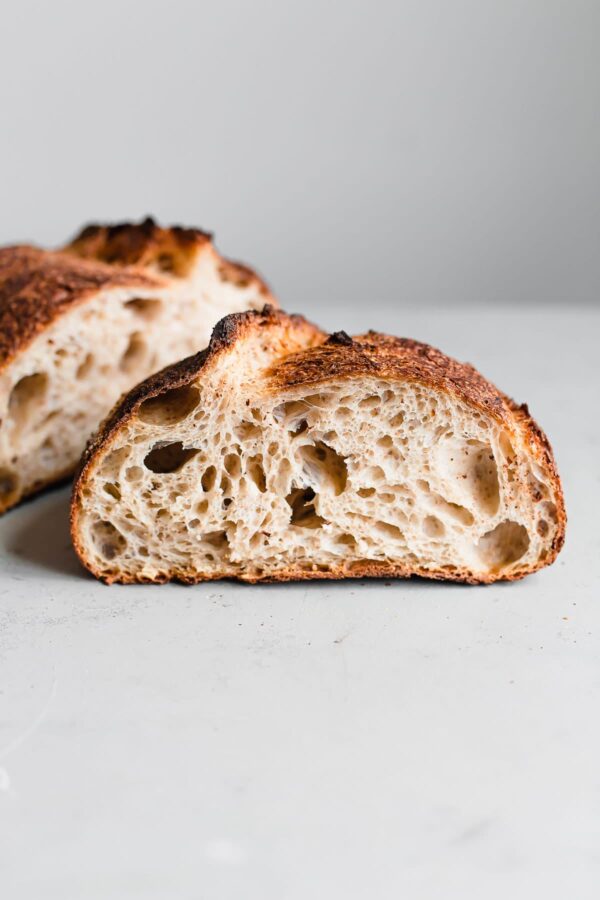
While it requires patience and dedication, bread baking has become a serious passion of mine. I created a sourdough starter nearly two years ago and bake bread (and sourdough pizza) at least once a week. I absolutely love it.
Recipe Note: This sourdough bread recipe offers a rough timeline, but will need to be adapted to meet your specific conditions. Ambient temperature, starter strength, and flour type (as well as other variables) affect fermentation and play a very important role in bread baking.
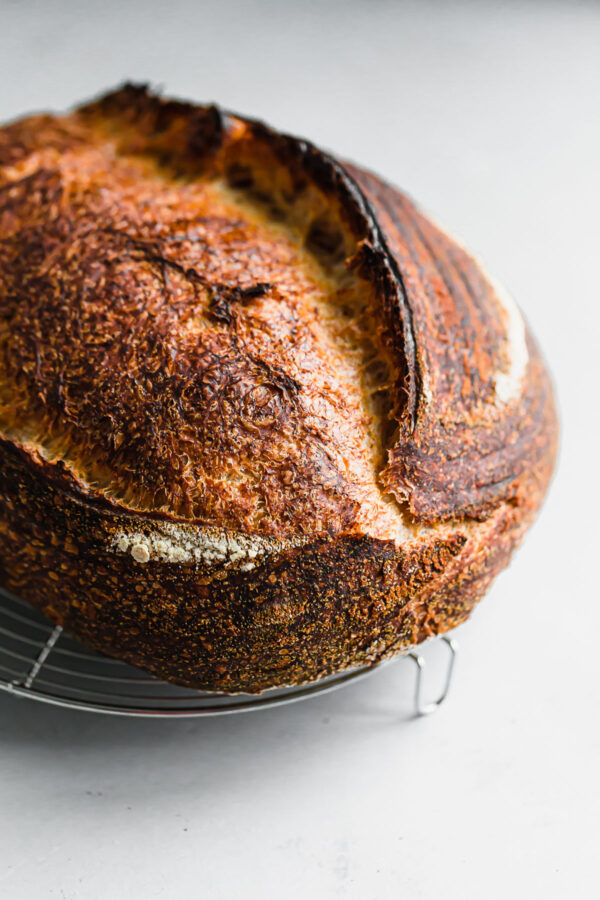
Sourdough Starter: The Basics
To make homemade sourdough bread, you’ll need an active, mature sourdough starter. I recommend The Perfect Loaf’s sourdough starter guide or Baker Bettie’s beginner guide.
You can also ask a fellow baker or bakery for some starter or even buy it online. Starters are active organisms and require daily feedings, unless they are refrigerated for short periods. The time commitment and work is minimal, but absolutely necessary for its viability.
If you have any questions, please read my Sourdough Starter Troubleshooting Guide for tips and guidance.
For more guidance and tips, check out my complete guide with my favorite sourdough tools and resources.
Common Mistakes To Avoid:
Once you have an active sourdough starter and a few basic tools (see a list below and complete guide here), you can start making sourdough bread. How exciting is that?!
How do I know if my starter is ready to use?
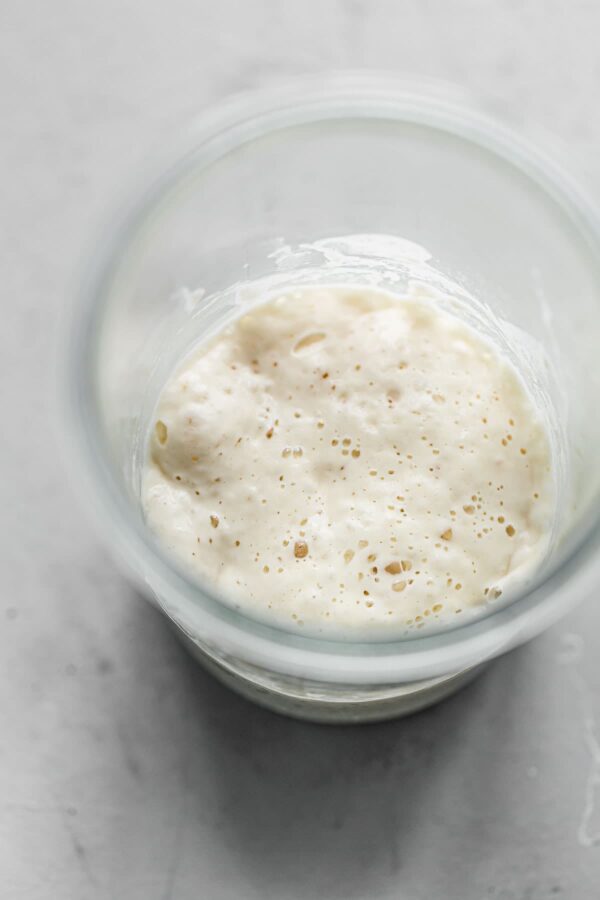
- You will need an active, mature sourdough starter to make this bread. It should be on a predictable feeding schedule. This will vary, but it should double or triple in volume between feedings.
- Ideally, your sourdough starter should require at least one, preferably two, daily feedings on 1:5:5 ratio. For more information on feeding ratios, please review my Sourdough Starter Troubleshooting Guide. While you can make bread with less active starters, you’ll need to watch the dough carefully and most likely have to extend bulk fermentation significantly.
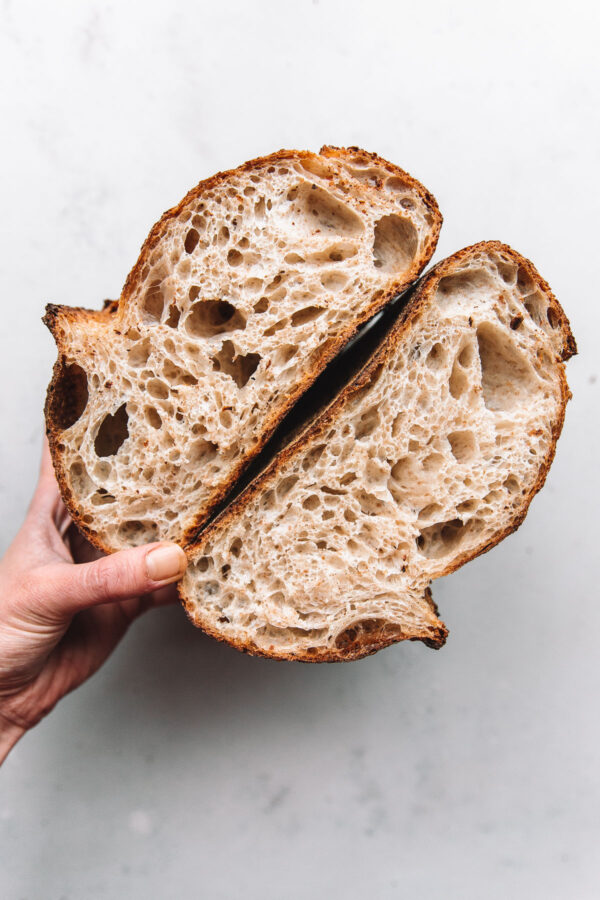
- The most common mistake for new sourdough bakers is poor fermentation and under-proofing, which is often the result of a weak or young sourdough starter. Under-proofing produces dense, gummy, and poor crumb structures.
- If your sourdough starter is sluggish, I recommend building up its strength with another week or two of feedings before baking again. Sourdough bread baking is a learning process and requires a lot of patience, as well as trial and error.
Troubleshooting Issues:
If you’re experiencing troubleshooting issues with this recipe or other sourdough baking, please check out my Sourdough Bread Troubleshooting Guide.
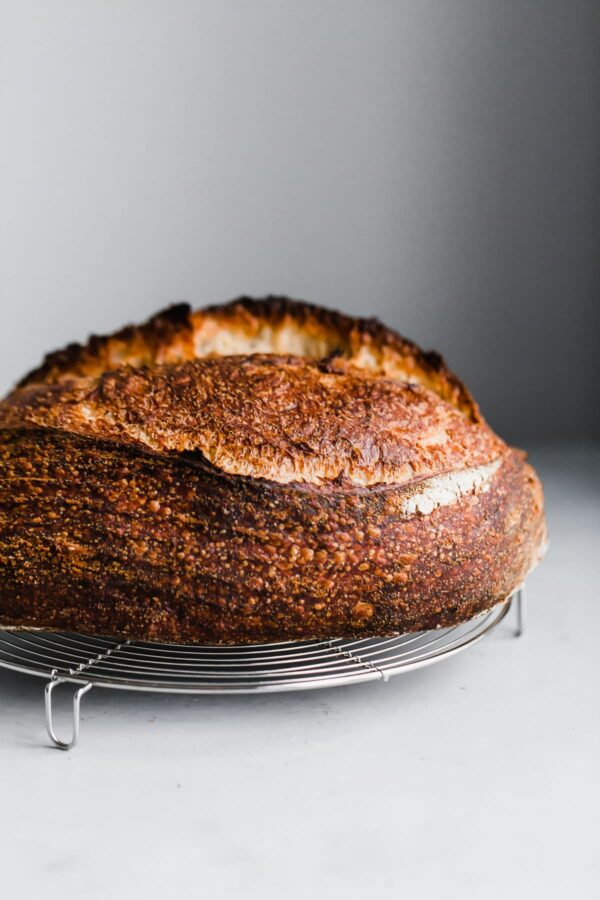
How to Make Artisan Sourdough Bread:
Important Note: Many sourdough bread recipes call for preparing an off-shoot levain (eg. starter) for baking. I prefer to use a portion of my ripe, just peaked starter. This eliminates one extra step, as well as works better for my normal feeding schedule and preferred baking timeline.
This choice is up to you and can be tweaked/adapted to fit your schedule or starter feeding schedule, but please plan accordingly. Either way, you’ll need to account for the starter amount in the recipe below (90 grams), as well as the normal amount required to maintain your mother (main) starter.
To prepare to bake the following morning, I scale up the previous night’s feeding to the following:
- 12 grams ripe starter
- 60 grams flour
- 60 grams water
*Note: This is a 1:5:5 ratio. You will need to adapt or tweak this to ratio to fit your own starter activity level.
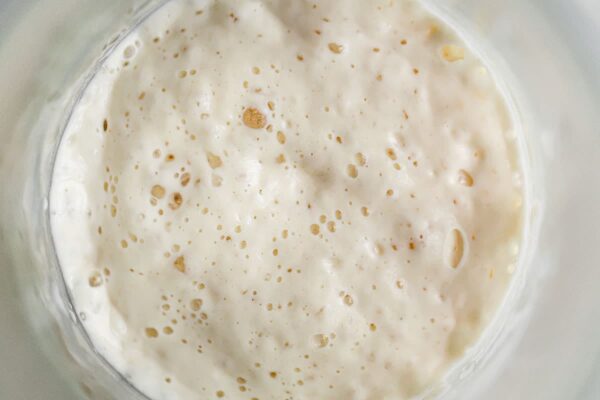
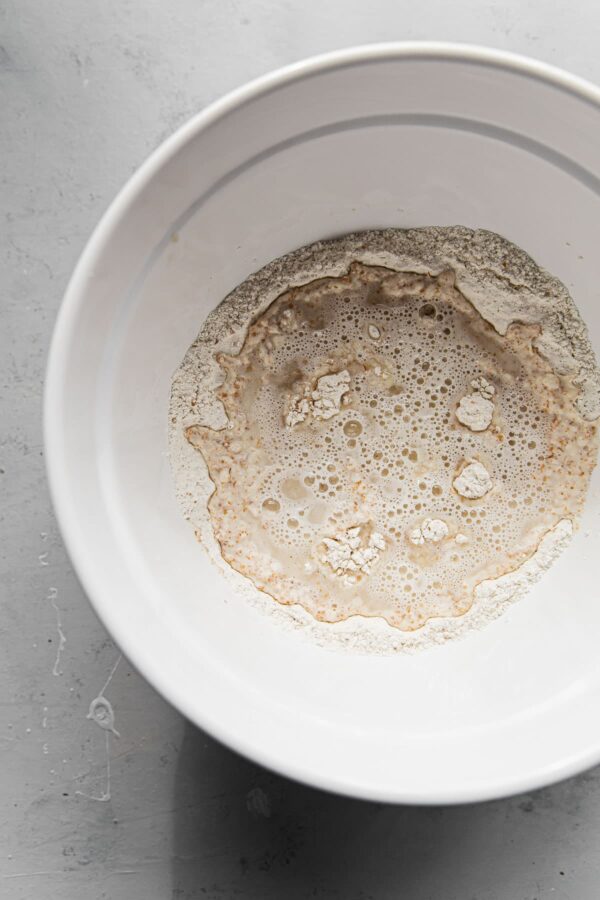
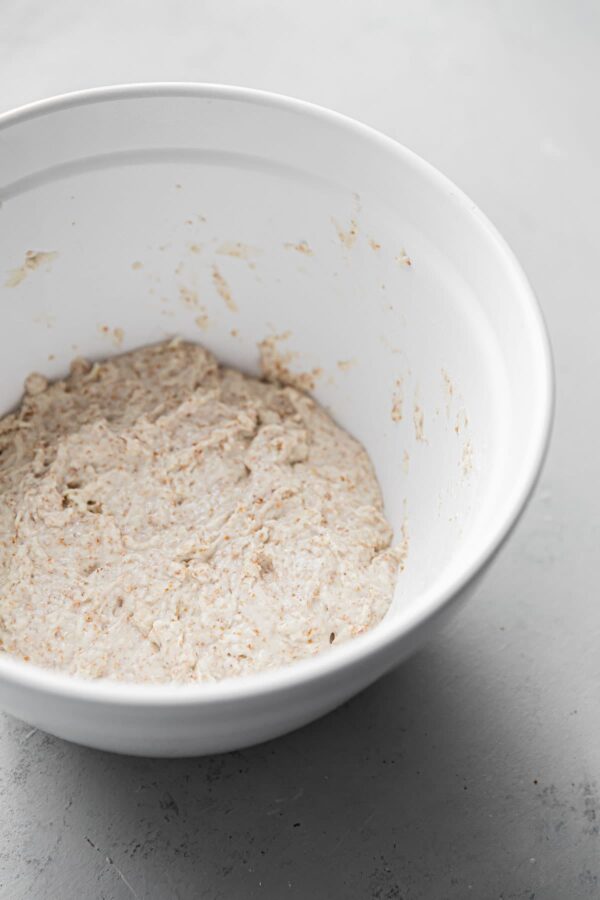
*Note: Before getting started, please watch my YouTube step-by-step instructional video. For a printable recipe and example baking timeline, please scroll down to the recipe box at the bottom of this post.
STEP 1: PREPARE THE AUTOLYSE
In a large mixing bowl, whisk together the flours. Add the filtered water (90°F/32°C) and mix with your hands until thoroughly combined and no dry bits are visible. It will be sticky. Cover the bowl with a clean shower cap or plastic wrap and rest at 80°F/26°C for a minimum of 1 hour or as long as 2 hours. This step hydrates the flours and helps with gluten development and dough structure.
I use my Brod & Taylor Proofing Box to maintain a relatively high ambient fermentation temperature. It is an amazing tool, but not necessary for sourdough baking. However, I recommend finding a warmer spot in your kitchen (was 74°F-76°F) for resting your dough. Cooler ambient temperatures will slow down fermentation and might extend bulk fermentation significantly.
*Planning Tip: Since this recipe doesn’t call for preparing an off-shoot levain, I mix and prepare the autolyse roughly one hour before my normal morning starter feeding time (ie. when my starter is ripe and has just peaked).
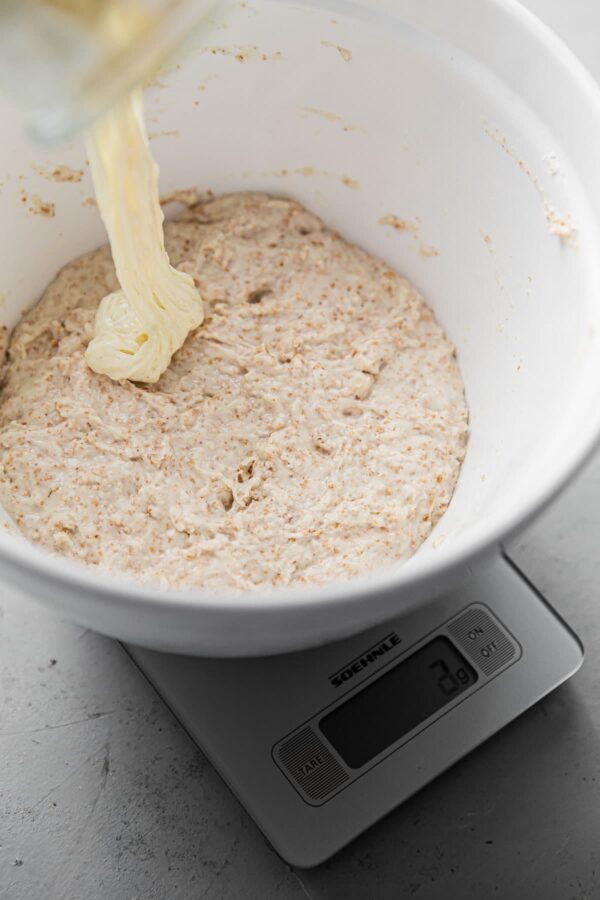
STEP 2: ADD RIPE STARTER AND REST FOR 30 MIN
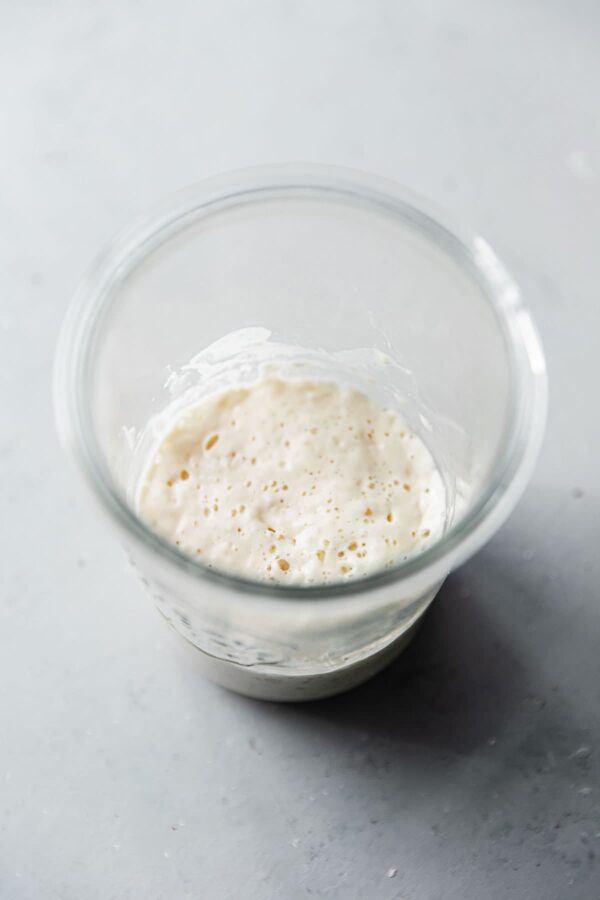
While this test isn’t fool-proof, your sourdough starter should pass the ‘float test’ when it’s ready to be used in your dough. Place a tiny spoonful of your ripe starter in a jar of water, it should float. If it sinks, it is not ready to use and usually requires additional time. Check and test again 15 to 20 minutes later.
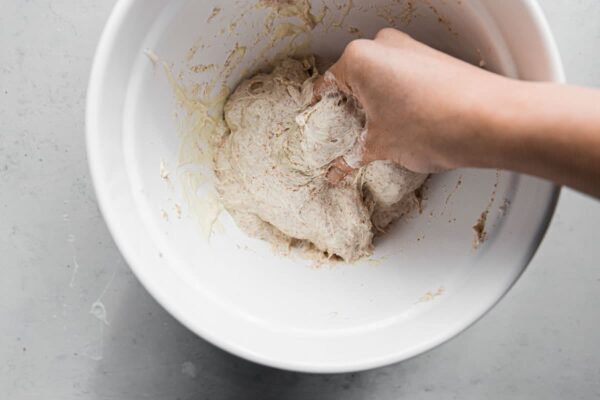
Add the ripe, just peaked sourdough starter. Use your fingertips to spread the starter over the autolyse mixture. Fold the edges of the dough into the center to fully incorporate the starter.
Use your thumb and fingers to pinch the dough (pincer method) repeatedly until the starter is well incorporated. Don’t be delicate. You want to work quickly, but fully incorporate the mixture. Cover once again and rest at 80°F/26°C for 30 minutes.
STEP 3: ADD SALT AND REST FOR 15 MIN
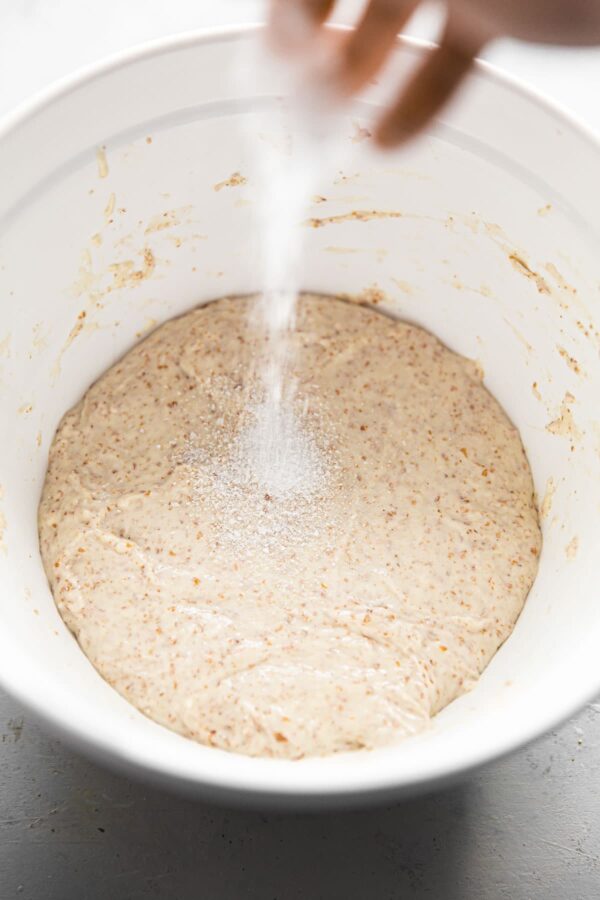
Sprinkle the salt over the surface of the dough. Use your thumb and fingers to pinch and incorporate the salt into the dough (you should not feel any granules at the end of mixing). Be thorough. Depending on the coarseness of the salt, this mixing step usually takes about 3 to 5 minutes.
If you’re struggling with higher hydration doughs and dough strength, there are two additional mixing methods that can try: slap and fold or the Rubaud method. Please see the full video included in this post for visual demonstration.
Cover and rest at 80°F/26°C for 15 minutes before preforming the first stretch and fold set.
STEP 4: BULK FERMENTATION (6 SETS OF STRETCH AND FOLDS)
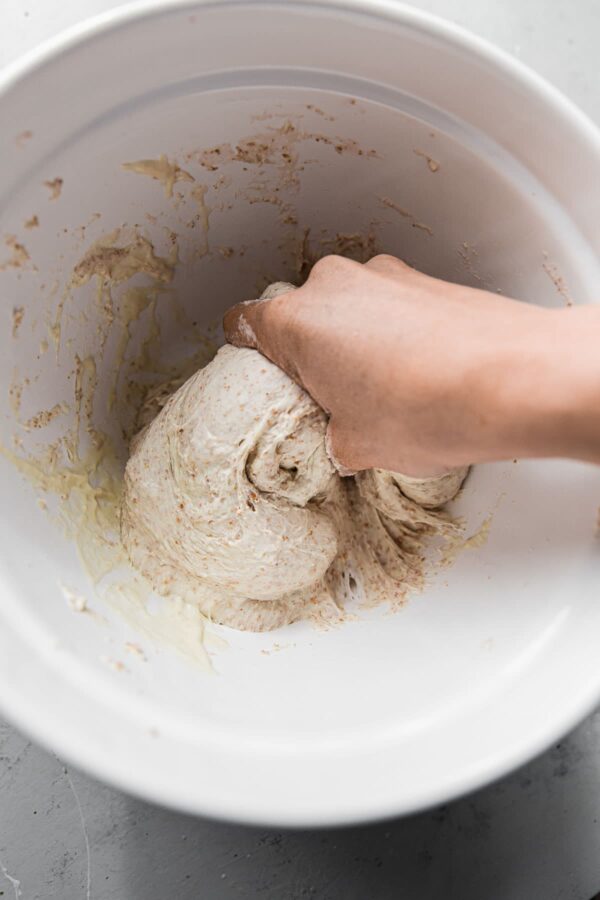
We’ll preform a total of six stretch and fold sets during the first two hours of bulk fermentation. The first three will take place in 15-minute intervals. The remaining three will occur in 30-minute intervals. Stretch and folds help build strength and extensibility in the dough, and encourage good crumb structure.
To complete a stretch and fold, dip you hands lightly in water (*this will help the dough from sticking). Be careful not to incorporate much water as this is already a high hydration dough. Grab the top portion of the dough with both hands. Gently pull and stretch it upwards (without tearing) and fold over the opposite edge. Rotate the bowl 180 degrees and repeat from the other side.
Rotate the bowl 90 degree and repeat once again on both sides. This entire process is one stretch and fold set. After performing the stretch and folds, I like to gently lift the dough to round it nicely in the bowl (see video).
Cover and rest the dough at 80°F/26°C between each set.
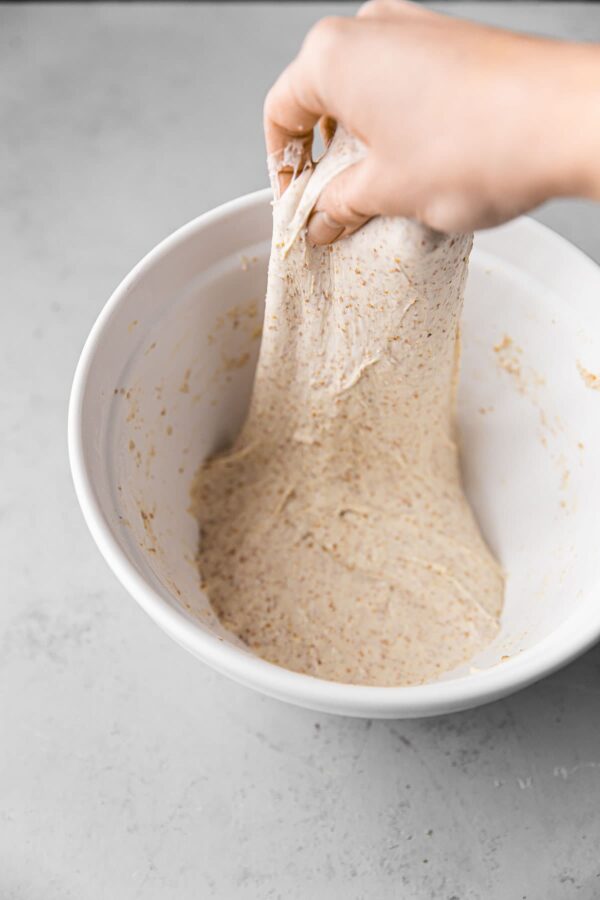
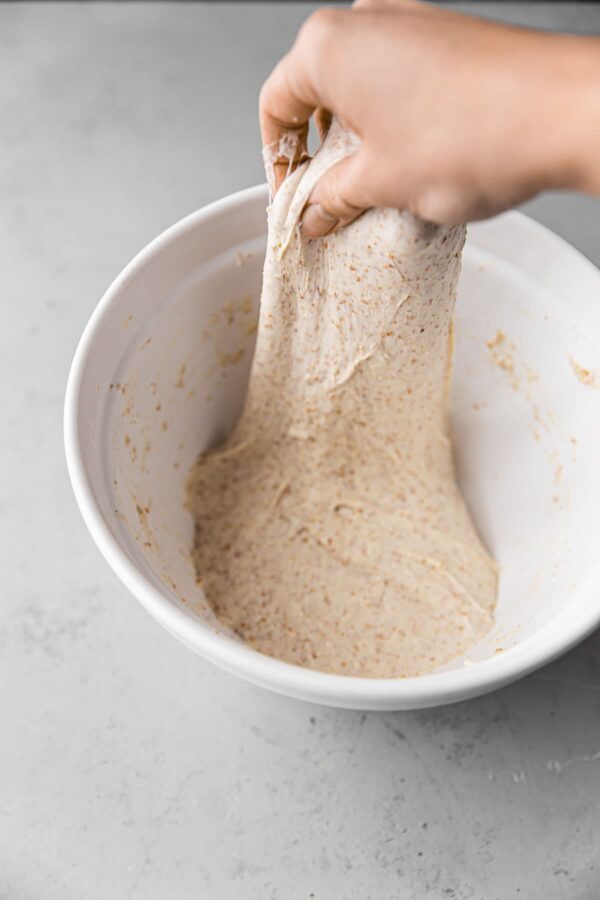
The dough will be very slack at the beginning of bulk fermentation. You’ll notice it building more and more strength as you complete more stretch and folds. Note: The dough will not rise or expand much during this first period.
If your dough is lower in hydration or starting to fight you, stop performing stretch and folds and allow it to rest for the remainder of bulk fermentation. The purpose of stretch and folds is to build strength, but if the dough is already strong, additional sets can have an unintended effect of pressing out gas bubbles.
STEP 5: BULK FERMENTATION (continued)
After you have preformed the stretch and folds, allow the dough to rest, covered, at 80°F/26°C for an additional 1.5 – 2 hours, or until it has nearly doubled in size. The total bulk fermentation time will vary tremendously based on your ambient kitchen temperature, dough temperature (FDT), flour type, and several other factors, so watch it carefully. Always follow the dough’s lead!
Judging the right point to end bulk fermentation and move to the pre-shape period requires practice and trial-and-error.
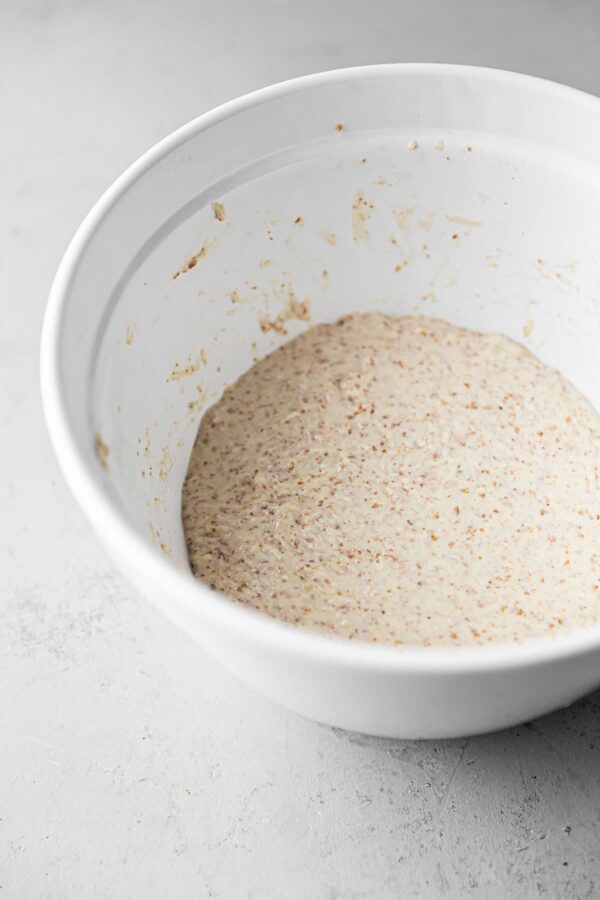
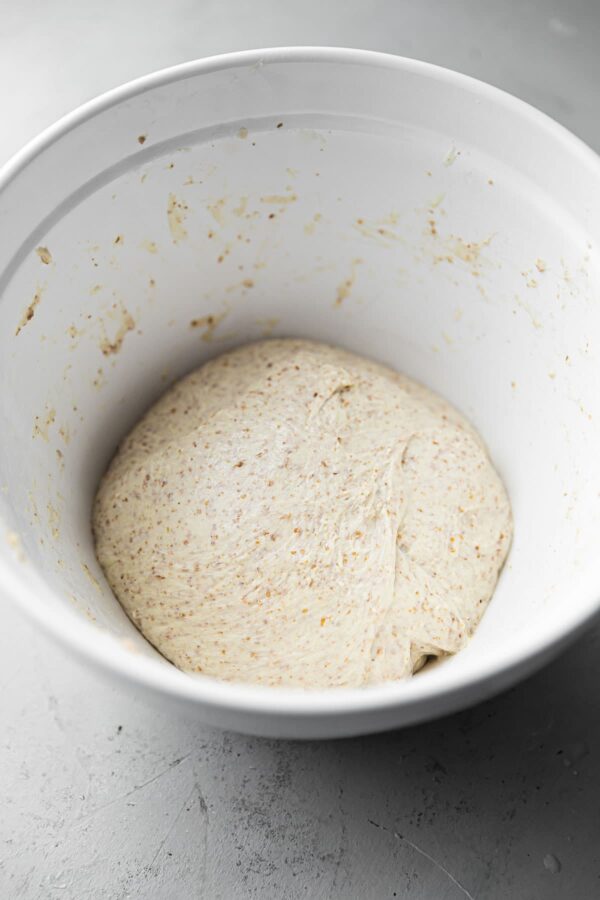
At the end of bulk fermentation, the dough should be well aerated and there will be many gas bubbles on surface, as well as on the edges of the bowl (see video). The dough should be slightly rounded on the edges of the bowl, if the dough is flat, you most likely didn’t build enough strength in the dough.
Generally, I like to end bulk fermentation when the dough is just under double in size. This has produced good results for me and this guideline works well for this specific sourdough process and timeline.
STEP 6: PRE-SHAPE
Carefully transfer the dough, without degassing, onto a clean countertop. It will be sticky. Use a bench knife to gently shape the dough into a round, pulling it gently towards you on the countertop to create some surface tension and strength.
As you do this, you’ll notice that the dough comes into a shape and starts to feel bouncy (see video). The key is to do this step quickly and as gently as possible. Rest the dough, uncovered, for 15 to 20 minutes, or until it has relaxed slightly for the final shaping.
STEP 7: FINAL SHAPE
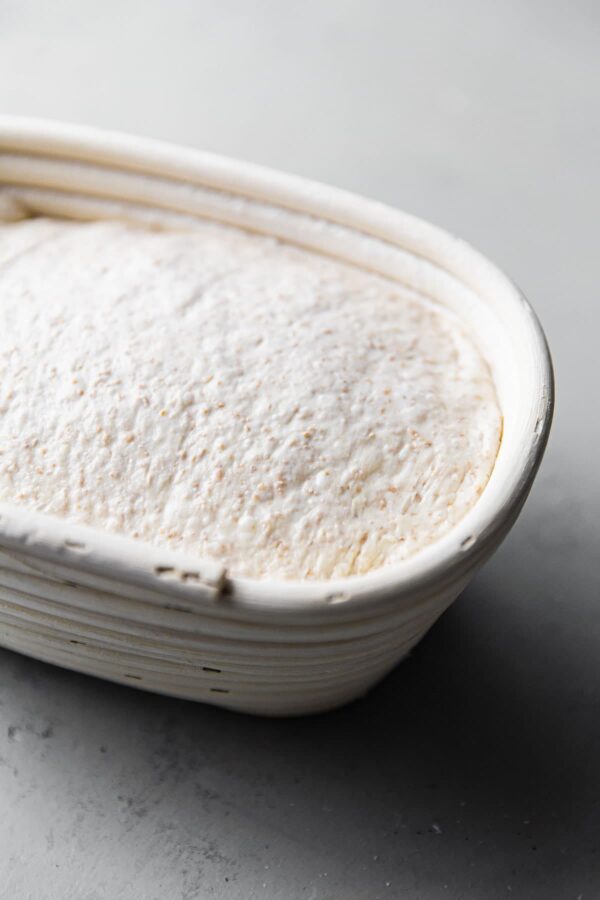
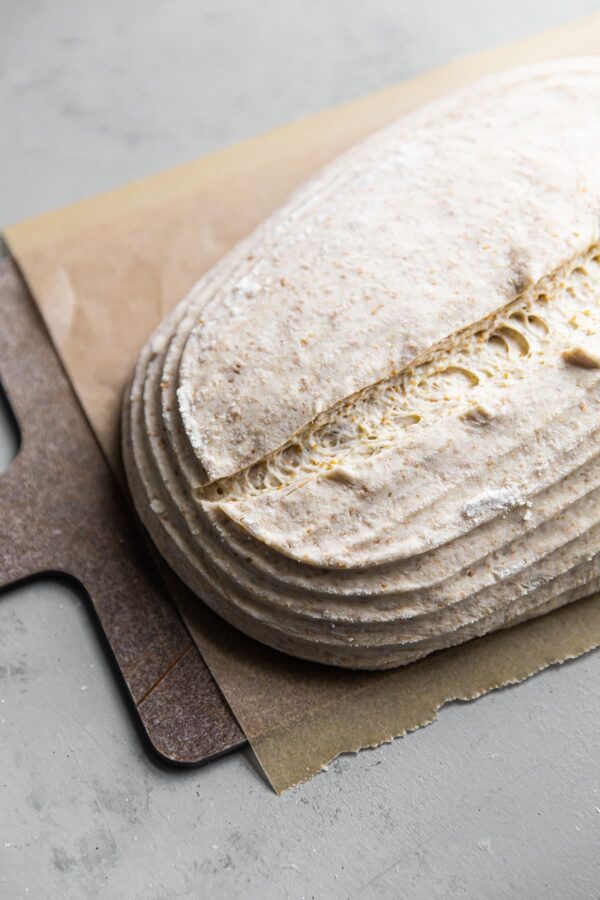
Dust the lined banneton basket lightly with rice flour. Lightly dust the surface of the dough with bread flour. Use a bench knife to gently lift it and flip it flour side-down onto your countertop. Shape into a batard (oval) (see video) or shape into a round depending on your basket and baking vessel.
Gently pick up the shaped dough, flip, and transfer into your floured banneton, with the seam side facing up. Drape a linen over the basket (to capture any condensation) and cover the banneton with a plastic bag. Seal with a clip and allow the dough to rest at room temperature for 10 minutes.
STEP 8: FINAL PROOF
Place covered banneton in the refrigerator and retard dough for 15 to 16 hours at 38°F/3°C. This slow and cold fermentation stage helps develop flavor and improves the final crust texture.
STEP 9: PREHEAT THE OVEN AND PANPreheat your Challenger Pan, Dutch Oven, or combo cooker (with lid) in a 500°F/260°C oven for at least 1 hour.
STEP 10: BAKE
Once the oven and baking vessel have preheated for an hour, remove the banneton from the refrigerator and uncover.
Poke Test: Test the dough for proper proofing by lightly flouring one small section (while the dough is still in the banneton). Press your finger lightly into dough. A properly proofed dough should very SLOWLY spring back and still leave a light indentation. That is a sign of a well proofed dough that is ready to be baked. If it springs back quickly and completely, it is under-proofed (return to the fridge, covered, for an additional hour or so). If the dough compresses and doesn’t spring back at all, it is over-proofed. Unfortunately at that point, it’s hard to make up for in that stage of the process – but it will still taste delicious!
Transfer the dough to the baking vessel – see recipe for more detailed instructions – and score the loaf with a bread lame. Please see recipe video for visual instruction. Bake at 500°F/260°C with the lid on for 25 minutes.
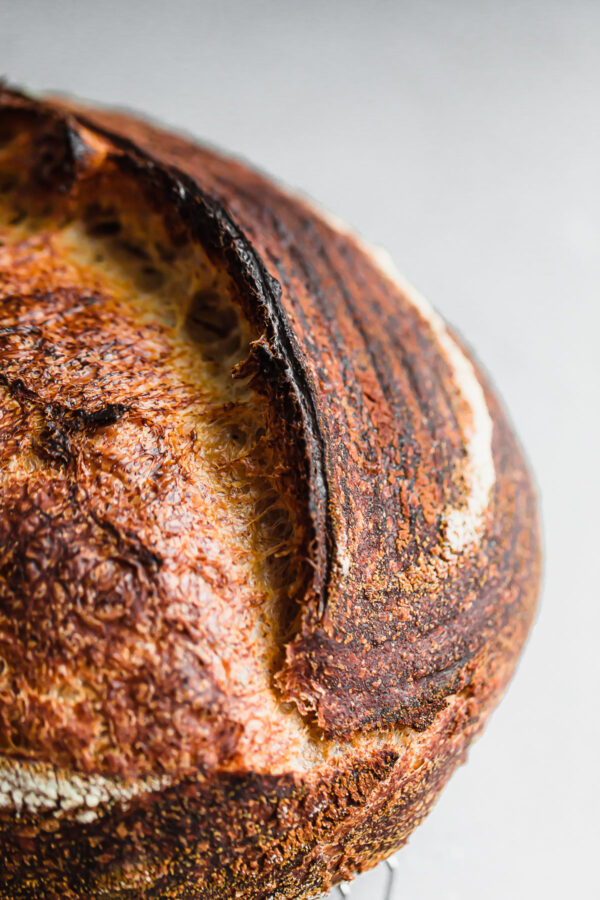
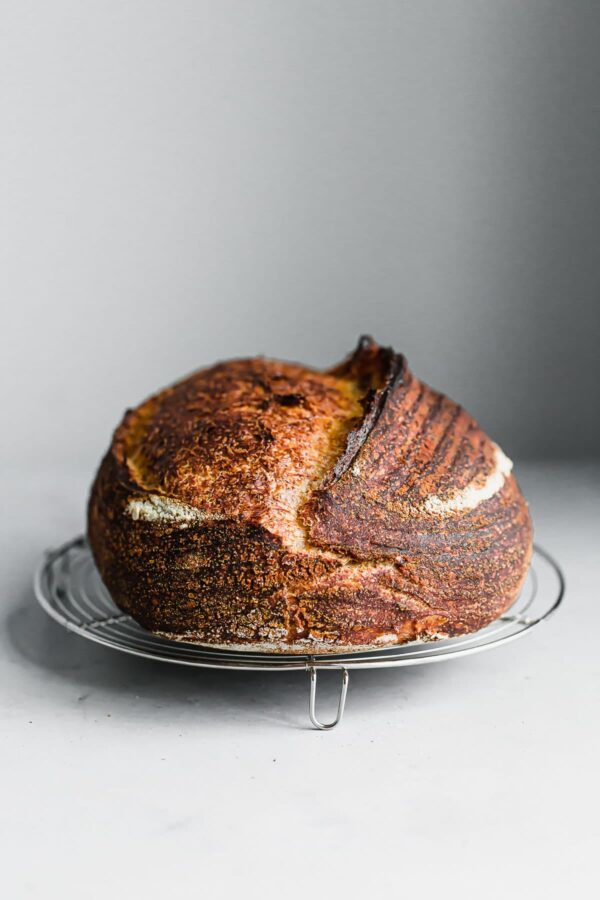
Remove the lid, reduce the oven temperature to 475°F/240°C (*note: if your oven runs hot or your loaves are browning too quickly, reduce the temperature to 450°F/232°C) and continue to bake uncovered for an additional 15-25 minutes or until the crust is deep golden and caramelized. I like to rotate the pan several times throughout baking to ensure even color.
Transfer to a cooling rack and cool completely before slicing. This will take several hours. Enjoy!
Artisan Sourdough Bread Ingredients:
- 350 grams bread flour (preferably organic)
- 90 grams whole wheat flour (preferably organic and stone-ground)
- 350 grams 90°F/32°C filtered water
- 90 grams ripe sourdough starter (100% hydration)
- 9 grams kosher salt or fine sea salt
- white rice flour, for dusting
Baker’s Percentages:
Use the following baker’s percentages to tweak and adapt this sourdough bread recipe to suit your own flour, hydration, or yield preferences. Please know the timeline might change. I recommend sticking to the same salt and sourdough starter percentages.
- Bread Flour: 79.5%
- Whole Wheat Flour: 20.5%
- Water: ~79.5% (*this is a rough hydration percentage – true hydration takes into account the flour and water in your starter)
- Sourdough Starter: 20%
- Salt: 2%
Recommended Equipment and Tools:
For this recipe, you’ll need at least the following. For a complete list, please reference my guide:
- Challenger Bread Pan (a great investment), 5 Quart Dutch Oven, or Combo Cooker
- Mature Sourdough Starter
- Instant Thermometer (I highly recommend Thermopen brand for the highest quality and accuracy)
- Baking Scale
- Bench Knife
- White Rice Flour, for dusting the banneton
- 8-inch Round or 11-inch Oval Banneton Basket (I recommend one that comes with a liner, especially if you are new to sourdough baking)
- Bread Lame (or razor blade or sharp scissors), for scoring
- Serrated Bread Knife
- Advanced Equipment Recommendation: Brod & Taylor Proofing Box
Example Bread Baking Timeline:
Use the example timeline to plan your schedule for weekday or weekend sourdough baking. This timeline can also be found in the printable recipe box below.
DAY ONE:
8:30 AM – autolyse (mix flours and water). allow mixture to rest, covered, at 80°F/26°C for 1 hour, or as long as 2 hours.
9:30 AM – add mature sourdough starter, mix thoroughly. cover and rest at 80°F/26°C for 30 minutes.
10:00 AM – add salt and mix thoroughly. cover and rest at 80°F/26°C for 15 minutes.
10:15 AM – 10:45 AM – stretch and folds #1, #2, #3 (every 15 minutes). cover and rest at 80°F/26°C between each set.
11:15 AM – 12:15 PM – stretch and folds #4, #5, #6 (every 30 minutes). cover and rest at 80°F/26°C between each set.
12:15 PM – 2:15/3:15 PM – allow dough to rest, covered, at 80°F/26°C for the rest of the bulk fermentation period. this period will range from 1.5 – 2 hours (or much longer), depending on ambient temperature, starter strength, and flour variety. generally, I like to end bulk fermentation when the dough is just under double in size. This has produced good results for me and this guideline works well for this specific sourdough process and timeline.
2:15/3:15 PM – pre-shape. leave uncovered at room temperature for 20 minutes.
2:35/3:35 PM – final shape. transfer to rice floured banneton basket, cover with a plastic bag, and seal. allow to rest at room temperature for 10 minutes before transferring to the fridge.
3:45 PM – 7:45 AM – retard dough (final proof) in refrigerator at 38°F/3°C for 16-17 hours.
DAY TWO:
6:45 AM – preheat Challenger Pan, Dutch Oven, or combo cooker in 500°F/260°C oven for at least 1 hour.
7:45 AM – remove dough from the fridge, transfer to preheated pan, score, and bake at 500°F/260°C with the lid on for 25 minutes.
8:10 AM – remove pan lid, reduce oven temperature to 475°F/245°C and bake uncovered for about 20 minutes or until deeply caramelized. allow loaf to cool completely – this will take several hours – before slicing and serving.
How to Store Sourdough Bread:
You’ll be amazed by how quickly you go through a loaf. If you do happen to have leftovers, please reference my guide on how to store bread.
It covers the basics on the best way to store, refresh, and freeze artisanal sourdough bread.
Troubleshooting Issues and FAQ:
If you’re experiencing troubleshooting issues with this recipe or other sourdough baking, please check out my Sourdough Bread Troubleshooting Guide.
Artisan Sourdough Bread Recipe
Ingredients
- 350 grams unbleached bread flour preferably organic, plus more for dusting
- 90 grams whole wheat flour preferably organic
- 350 grams 90°F/32°C filtered water
- 90 grams ripe sourdough starter 100% hydration
- 9 grams Diamond Crystal kosher salt or fine sea salt
- white rice flour for dusting your banneton basket
Instructions
- New to sourdough baking? I highly recommend reducing the hydration in this recipe if you are new to sourdough baking. This is a high hydration dough and can be challenging to work with (and build strength in) if you're not an experienced baker. If you're looking for an easier to handle dough, I recommend reducing the water to 310 to 330 grams total. If you're working with a lower hydration, you may be able to get away with just 3 to 4 sets of stretch and folds, or even less. Follow the dough's lead!
- IMPORTANT NOTE: I do not prepare an off-shoot levain for my sourdough baking, as this baking timeline and method works well for my schedule, as well as my starter's feeding schedule. This choice is up to you and can be adapted/tweaked to fix your schedule, but please plan accordingly. Keep in mind that you'll need to account for the starter quantity in the recipe (90 grams), as well as the normal quantity needed to continue to maintain and feed your starter.
- Autolyse: In a large mixing bowl, whisk together 350 grams unbleached bread flour and 90 grams whole wheat flour. Add 350 grams (90°F/32°C) filtered water and mix with your hands until thoroughly combined and no dry bits are visible. Cover with a clean shower cap or plastic wrap, and rest at 80°F/26°C for 1 hour or up to 2 hours. This step hydrates the flours and helps build dough structure.
- Add Starter and Rest: While this test isn't fool-proof, your sourdough starter should pass the 'float test' when it's ready. Place a tiny spoonful of your ripe starter in a jar of water, it should float to the top. If it sinks, give it more time (15 to 20 minutes) and test again. Add 90 grams ripe sourdough starter and spread it over the autolyse mixture. Use your fingertips to spread the starter over the autolyse mixture. Fold the edges of the dough into the center to fully incorporate the starter. Use your thumb and fingers to pinch the dough (pincer method) repeatedly until the starter is well incorporated. Don’t be delicate. You want to work quickly, but fully incorporate the mixture. Cover and rest at 80°F/26°C for 30 minutes.
- Add Salt and Rest: Sprinkle 9 grams salt over the surface of the dough. Use your thumb and fingers to pinch and incorporate the salt thoroughly (you shouldn't feel any granules at the end of mixing) into the dough. Depending on the coarseness of your salt, this might take a couple minutes. Be thorough. Cover and rest at 80°F/26°C for 15 minutes. Important Note and Tip: If you’re struggling with higher hydration doughs and dough strength, there are two additional mixing methods that you can try: slap and fold or the Rubaud method. Please see the full video included in this post for visual demonstration.
- Bulk Fermentation: We will preform a total of 6 sets of stretch and folds (see article above for further instruction) in the first two hours of bulk fermentation. The first three will take place in 15-minute intervals. The remaining three will occur in 30-minute intervals. Covering and rest the dough at 80°F/26°C between each set. The dough will not rise much during the stretch and fold period, but it should get considerably stronger. Dip your hands in water (to prevent sticking) before each fold. I like to rub my hands together to avoid incorporating much more water, as this is already a high hydration dough. How to Preform a Stretch and Fold: Grab the top portion of the dough with both hands. Gently pull and stretch it upwards (without tearing) and fold over the opposite edge. Rotate the bowl 180 degrees and repeat from the other side. Rotate the bowl 90 degrees and repeat once again on both sides. This entire process is one stretch and fold set. After performing the stretch and folds, I like to gently lift the dough to round it nicely in the bowl (see video). *If your dough is developing quickly, you can reduce the total number of stretch and folds to 3 or 4 sets, 30 minutes apart.
- Bulk Fermentation (continued): Allow the dough to rest, covered at 80°F/26°C, for an additional 1.5 - 2 hours after the last stretch and fold - watch it carefully. Generally, I like to end bulk fermentation when the dough is just under double in size. This has produced good results for me and this guideline works well for this specific sourdough process and timeline. The total bulk fermentation time will vary tremendously based on your ambient kitchen temperature, dough temperature (FDT), flour type, and several other factors, so watch it carefully. Judging the right point to end bulk fermentation and move to the pre-shape period requires practice and trial-and-error. At the end of bulk fermentation, the dough should be well aerated and there will be many gas bubbles on surface, as well as on the edges of the bowl (see video). The dough should be slightly rounded on the edges of the bowl. If the dough is flat, you most likely didn’t build enough strength during mixing, stretch and folds, or bulk.
- Pre-Shape: Transfer the dough, without degassing, onto a clean countertop. It will be sticky. Use a bench knife to gently shape the dough into a round, pulling it gently towards you on the countertop in a circle to create some tension on the skin of the dough. As you do this, you’ll notice that the dough comes into a shape and starts to feel bouncy (see video). The key is to do this as quickly and gently as possible. Rest the dough, uncovered, for 15 to 20 minutes, or until it has relaxed slightly for the final shaping. Pre-shaping gives the dough some extra tension and strength (and is particularly important if you are doubling the recipe and preparing two loaves, as you'll need to divide it prior). Allowing it to rest allows the gluten to relax slightly before preforming the final shape.
- Final Shape: Dust a 9-inch round or 10 or 11-inch oval banneton basket with rice flour (be extra liberal if you are not using a cloth or linen liner). Dust the surface of the dough lightly with bread flour. Use a bench knife to gently lift and flip it flour side down onto your countertop. Depending on your preference, banneton, or baking vessel, shape the dough into a round or batard. *Tip: Please watch the video above for visuals on how to shape a batard (oval loaf) or my latest video on how to shape rounds (boules) and bake in a Dutch oven. After shaping, gently pick up the shaped dough, flip, and transfer into your floured banneton, with the seam side facing up. Drape a kitchen linen over the banneton and place the banneton in a plastic bag (*I use a clean plastic produce bag). Seal with a clip and allow the dough to rest at room temperature for 10 minutes.
- Final Proof: Place covered banneton basket in the refrigerator and retard dough for 15-16 hours at 38°F/3°C. This slow and cold fermentation stage helps develop flavor and improves the final crust texture.
- Preheat the Oven: Preheat your Challenger Pan, Dutch Oven, or combo cooker (with lid on) in a 500°F/260°C oven for at least 1 hour.
- Poke Test for Proofing: Once the oven and baking vessel have preheated for an hour, remove the banneton from the fridge and uncover. Test the dough for proper proofing by lightly flouring one small section (while the dough is still in the banneton). Press your finger lightly into the dough. A properly proofed dough should very SLOWLY spring back and still leave a light indentation. That is a sign of a well proofed dough that is ready to be baked. If it springs back quickly and completely, it is under-proofed (return to the fridge, covered, for an additional hour or so). If the dough compresses and doesn’t spring back at all, it is over-proofed. Unfortunately at that point, it’s hard to make up for in that stage of the process - but it will still taste delicious!
- Transfer and Bake: If you are using a Challenger Pan or combo cooker, you can skip parchment and carefully invert the basket directly into the preheated base before scoring. If you are using a traditional Dutch oven, please watch this video for visuals: Place a large piece of parchment over the banneton, then top with a thin cutting board. Invert and flip carefully, so that the banneton is upside down, setting it down onto your countertop. The dough should release, right side up, from the banneton onto the parchment. Trim any excess parchment paper, creating two handles on both ends for lifting the dough. Use a bread lame to score the dough (1/2-inch deep), carefully transfer into the preheated pan, cover tightly with the lid, and place in the oven. Bake covered at 500°F/260°C for 25 minutes.
- Remove the lid. The dough should have risen and expanded considerably, and the crust should be set, but only lightly golden in color.
- Reduce the oven temperature to 475°F/240°C (*note: if your oven runs hot or your loaves are browning too quickly, reduce the temperature to 450°F/232°C) and continue to bake uncovered for an additional 15-25 minutes or longer until the crust is deep golden and caramelized. I like to rotate the pan several times during this final stage to ensure even browning.
- Carefully remove the bread from the pan and transfer to a cooling rack. Cool completely before slicing. This will take several hours. Slicing into warm bread will result in a gummier texture and cause the bread to stale faster. For more tips, read this guide on how to store, freeze, and refresh sourdough.
How to Adapt This Recipe:
- Feel free to adjust the flour type percentages and hydration to suit your preferences, using the same total flour weight as a guide. Higher quantities of whole grain flours will yield a denser, less open crumb and will affect total bulk fermentation time.
Example Baking Timeline:
- DAY ONE: 8:30 AM - autolyse (mix flours and water). allow mixture to rest, covered, at 80°F/26°C for at least 1 hour or up to 2 hours. 9:30 AM - add sourdough starter, mix thoroughly. cover and rest at 80°F/26°C for 30 minutes. 10:00 AM - add salt and mix thoroughly. cover and rest at 80°F/26°C for 15 minutes. 10:15 AM - 10:45 AM - stretch and folds #1, #2, #3 (every 15 minutes). cover and rest at 80°F/26°C between each set. 11:15 AM - 12:15 PM - stretch and folds #4, #5, #6 (every 30 minutes). cover and rest at 80°F/26°C between each set. 12:15 PM - 2:15/3:15 PM - allow to rest, covered, at 80°F/26°C for the rest of the bulk fermentation period. this period will range anywhere from 1.5 to 2 (or significantly longer), depending on ambient temperature, starter strength, and flour variety. follow the dough's lead! 2:15/3:15 PM - pre-shape. leave uncovered at room temperature for 20 minutes. 2:35/3:35 PM - final shape. transfer to rice floured banneton basket, cover with a plastic bag, and seal. allow to rest at room temperature for 10 minutes before transferring to the fridge. 3:45 PM - 7:45 AM - retard dough (final proof) in refrigerator at 38°F/3°C for about 16 hours.
- DAY TWO: 6:45 AM - preheat challenger pan, Dutch Oven, or combo cooker in 500F oven for at least 1 hour. 7:45 AM - remove banneton from fridge, transfer dough to preheated pan, score, and bake at 500°F/260°C, covered, for 25 minutes. 8:10 AM - remove pan lid, reduce oven temperature to 475°F/240°C, and bake uncovered for an additional 20 minutes or until deeply caramelized. allow loaf to cool completely (this will take several hours) before slicing.
277 Comments on “Artisan Sourdough Bread Recipe”
Hi Laura,
I apologize for the perceived negative rating. I didn’t even realize I had done that.
I have gone through all of your comments and FAQs prior to reaching out. As you know, the amount of time invested prior to shaping the dough is substantial and I was simply frustrated.
I have baked bread for years with a reasonable amount of success and want this recipe to work as the flavor And texture is incredible even if the loaf is a bit flat. I will reach out to Sunrise to find out the protein level of the flour and reduce the water more substantially next time.
I will update you on my results and appreciate your response.
It’s ok! I just would have been happy to have troubleshooted earlier with you, as I know that sourdough baking can be frustrating. I had a chance to look up some information about Sunrise bread flour and noticed it’s a fresher, organic flour. I’ve found that when working with local freshly milled flours, the fermentation can go much faster than with a standard grocery story bread flour (like King Arthur, which is what this original recipe was tested with extensively – but I’ve also made it many many times with fresh local flour).
I would definitely recipe reducing the bulk time. It seems that you may be judging bulk more by the appearance of bubbles (a good sign of fermentation, but definitely not a good sign to rely on as every dough will exhibit differently characteristics). You should be more looking for 60% rise in volume, and the dough should feel alive when you jiggle the bowl back and forth. This is a better measure. This time will all vary based on your ambient temperature (not sure what temperatures you’re working with).
I would definitely recommend reducing the hydration either way – and maybe start at 300 grams total just as you get a better feel for what to look for. This should help with structure. Let me know how it goes!
I am extremely frustrated. This is now my third attempt with your recipe and I cannot seem to develop adequate structure.
My starter is several months old and very healthy. It passes the float test prior to use and I am using Sunrise Bread Flour.
Everything seems fine until it is time for the prehape when it just doesn’t to it come together like yours does. At the end of the bulk fermentation it is lovely, with slightly rounded edges and lots of large gas bubbles. It seems almost too wet at the end of bulk.
Any suggestions on how to get over this hurdle? I have probably watched your video a hundred times and I know what it is supposed to do, but mine isn’t doing it.! I even cut the water back by 10 grams this time to help.
Hi Nancy. To me, although every dough will develop differently and I’m not familiar (nor do I know the protein level of Sunrise bread flour – which is VERY important), it sounds like you are over proofing your dough and the bulk fermentation is being extended too far. The dough shouldn’t be extremely wet at preshape – slightly sticky but not wet. That is usually a sign of over proofing/or a dough that cannot handle that quantity of water (every brand of flour has different absorption and strength qualities and reducing the hydration by just 10 grams is insignificant. I always suggest starting much lower if you don’t know how your flour behaves – at least 40-50 grams). I’d really appreciate it if you didn’t leave a negative recipe rating before reaching out with troubleshooting questions and asking for more assistance earlier. I also have a troubleshooting guide that is linked in this post that covers your issue.
Sourdough is extremely complicated and I can assure you that my recipe works but will always require adjustments from each Baker because we’re all working with different variables (not under my control) and sourdough is a living thing – unlike all other types of baking and cooking.
Thanks a lot for the recipe and the video. It was my first sourdough bread that actually worked out and it was amazing. Could have tasted a little bit more like sourdough. Would you have an advice how I could get that?
If you’re looking for a flavor similar to old school San Francisco sourdough, that is not really common with most home artisan sourdough and not what you’ll ever get with this recipe. That is actually flavor additive.
Flavor is subjective, so it’s hard to know what you mean, but you can increase the sourness by incorporating more whole grains, holding the dough at a warmer temp, or using a sourdough starter that has been pushed a bit farther (and is partially whole grain) just past peak.
Laura, thank you for your detailed recipe and video. Today was my first time making sourdough and it turned out close to perfect despite not having a banneton (I used a loaf tin for the proof but will be investing in a banneton!), lame or dutch oven. I ended up taking the loaf out of the refrigerator a little bit earlier to give it the poke test and I’m so glad I did – I will definitely be using this recipe again. I’m now working on maintaining a slightly smaller starter as I plan to bake a loaf a week! Thank you again.
This recipe is an awesome winner! My loaf came out so great . Thank you
So happy to hear that!
Great recipe, this is my second time following it. I ran into a problem today, I finished the stretch and folds, and then during the bulk rise, was called away and would not return in time to shape it. Is it possible to complete the bulk rise in the fridge?
Hello! I made this bread this week and I will be doing it again! It was so amazing! I didn’t time it out the same way but it still worked. Thank you for taking the time to post this. I also made your asian salmon and noodle recipe and we loved it!!
Your recipe has great instructions. I am new ( few months in) to sourdough bread baking. I have been struggling with understanding how long to bulk ferment. Your recipe worked really well- the dough was acting like described in recipe finally ( goal). When I baked it in morning, so excited to see great rise and shape – best yet!
When I cut / sliced it open 5 hours later- it was cold to touch—had great oven spring- airy; but the texture is still gummy.
What am I missing?
Just made this for the first time and it’s the best bake I’ve ever gotten for a loaf of sourdough. I used the lower hydration and white whole wheat flour. Beautiful crumb and great oven spring. Thanks!!
Hi Laura I love your clear and straightforward explanations and the results are awesome!
Just one question… In your schedule, what time do you feed your starter at the 1-5-5 ratio on the day before so that it will be ready to add to the autolyse mixture on the following morning?
Many thanks, Barry
For my first time sourdough bread I tried your recipe and process with minor changes. You have explained it in so much detail and it’s so clear even for someone new to this bread. Thank you ?! Mine came out perfect and I am so happy! Doing it just once felt like it took so long, but I could just get back to your video and start back from where I had left it. It’s perfect!
I have been looking for a perfect soft sandwich bread Recipe using the sourdough starter and will check if you have it on your blog.
This recipe has helped me so much! I wish I could post a pic of my beauty!
Yay! So happy to hear that. I’d love if you could share it with me on Instagram (if you’re over there!) – my username is @abeautifulplate
Thank you! Very good instruction and easy to follow. Lots of detail though, but they are the critical point. I am working on the second one. The first one is real success. However, When I working on the second one….. while I take it out for shaping on the counter, I kind of kill it. I mean I think I let out too many air from the dough. After shaping it, I let it sit on the counter longer before placing it in the fridge to let it raise a bit. Hope it will ferment more. Do you think it will work. I know I will find out tomorrow, but would like to know your opinion.
Again. Thanks for the good recipe.
Forgot to rate 5 star earlier
As expected, it did not raise as high as the first one. But still a good bread. Thanks Again. Still would like to know if there is any way to rescue if I let out some air during shaping after the fermentation for 2 hrs. (the step on the counter top.)
Thanks
Su
So excited to try this recipe this week! I have tried couple water salt and yeast recipe and they turned out pretty good. If I increase whole wheat proportions to 40% ~ 60%, do you recommend overnight fridge autolypse to increase dough strength? Would I be needing more stretch and fold?
Thank you!
No, I don’t do overnight autolyses (these can be done, but it should not be necessary for that variation) and you shouldn’t need to do that with this recipe in order to substitute that amount of whole grain. You will most likely need to increase the water slightly and just see how the dough feels – if it needs an extra stretch and fold, definitely do it! Sorry, I can’t be super specific because every dough and flour will behave differently.
Finally a sourdough loaf that feels light for its size! It’s springy, crusty and smells wonderful! I haven’t sliced it yet (still cracking & popping). Given that the starter must be robust and multiple lamination/foldings are requisite for those larger pores, the MOST helpful tip was seeing how bubbly your dough was in final shaping! So while the recommended 2hrs did not yield that picture (still kind of flat). 4 hrs did. I believe the waiting paid off in a larger, looser crumb, it did cost me a good ‘ear’. Will definitely attempt again and control for ambient temperature to attain a 2hr rise for shaping. Thank you for a well-tested sourdough recipe!
They is a great recipe that ticks all the boxes for me. One great sized loaf, time line schedule to assist with planning, wonderful instructional video to see things in action and most importantly a great bake. I’ve had my starter for a few years but only started using it for bread baking. Lots of crackers, waffles and nann bread before that 🙂
Do you have any tips for adding flavouring to this? I’m thinking chives and cheddar cheese ?
I thought before the 3rd set of folds would be a good time and to start around the 20% mark with the cheese.
Also any ideas on cooking time for dividing the dough into 6 for mini boules still cooked in a Dutch oven?
Thanks for you help and again awesome job on the recipe and resources! ????❤️
I made twice the recipe because I wanted two loafs. I started all the folds and i’m Finished with that but I’m stuck when I should have cut the dough in half. Hope I didn’t screw it up
Thanks pete
If you double the recipe, you would want to divide the dough with a bench knife just before pre-shape.
The first few times I made my sour dough my loaves came out nicely. The last few times I have really struggled. I have used what flour I can find King Arthur, Pilsbury, Wegman’s, since where I live it is often in short supply. I followed your recipe closely and put my dough in the bannetons for the long cold proof. However when I took them out to bake they had shrunk instead of rising! I am dumbfounded. I am newer to this kind of sourdough, but am a fairly experienced baker. I’ve never seen a dough do this before.
Hi Shari! I suspect the variances in your flour choices could be creating issues, or that this is a higher hydration dough (not sure if youre familiar with those). Are you substituting all purpose for bread? Different brands vary tremendously on protein percentages, which means they will all behave a bit differently in terms of strength, gluten formation, water absorption, etc.
The dough shouldn’t rise almost at all in the fridge – since I’m recommending a very cold fridge temp. However, if the dough is shrinking or collapsing, it sounds like it could be due to 1) over proofing – be careful with your bulk fermentation time, 2) strength issues (maybe you are using too much water for what your flour can handle, so I always recommend reducing hydration when working with a different method), 3) strength issues related to stretch and folds, shaping, etc.
I hope this gives some help, but there are so many variables involved, it’s hard to troubleshoot much beyond that without more detail. Have you watched the YouTube video? It might give more insight into what the dough should look and feel like at various stages.
This detailed recipe and video were SO HELPFUL. I followed this very closely (especially the video) and made my first successful sourdough bread. The second time I made it, it came out even better than the first. The oven spring was higher and it even had an ear! Thank you so much for taking the time to craft such a thorough guide.
Perfect loaf!