

Salt and Why The Type and Brand You Use Matters
You know how I mentioned that I want to write about cooking and try some new things? I’m channeling my inner cooking nerd and doing just that.
Today I’m taking a deep dive into cooking salts. Why? This topic fascinating and, more importantly, sorely neglected in the recipe world.
A few weeks ago, I shared my favorite books to become a better cook. It was so well received that I couldn’t help but wonder, “why am I not writing about this stuff more often?” I mean, a) I love learning about it, b) I studied this in culinary school, and c) I truly want this website to be both a recipe and cooking resource.
Things are going to get a bit technical today. If you love to cook, I have a feeling you’ll get some incredibly powerful knowledge out of today’s post.
Today’s topic is something I should have addressed years and years ago. Why? Because salt is included in every recipe on this site. Salt is the most important ingredient in your kitchen pantry. Learning how to properly season your food is one of the most powerful cooking skills that you can learn.
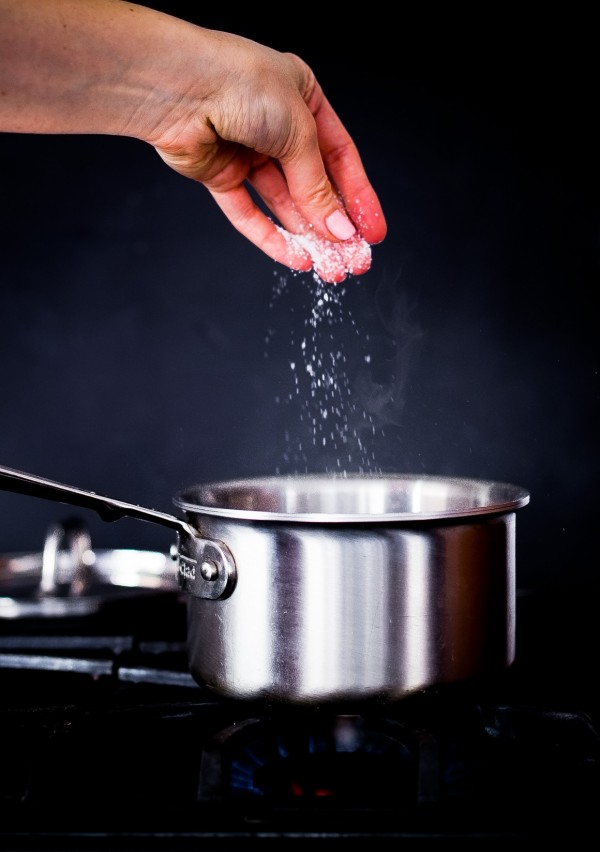
If you’ve ever stood in the grocery aisle and stared at the huge variety of salts available, you know it is easy to feel overwhelmed and confused.
You may have wondered why some recipes call for kosher salt, sea salt, or fill-in-the-blank salt. I’m here to shed some light on the topic.
Quick Summary:
Salts are not interchangeable. More importantly, the brand and variety of salt you buy and use affects every single recipe you make. Yes, every single recipe.
In other words, if you’re following a recipe and it calls for “1/4 teaspoon of ___ salt” (or worse, a recipe simply states “1/4 teaspoon salt” and does not specify the variety or brand of salt), you can unknowingly use as much as TWO to FOUR to SIX TIMES the quantity of salt the recipe was designed to contain.
How is that possible? Because every type and, more importantly, every brand of salt differs dramatically in density.
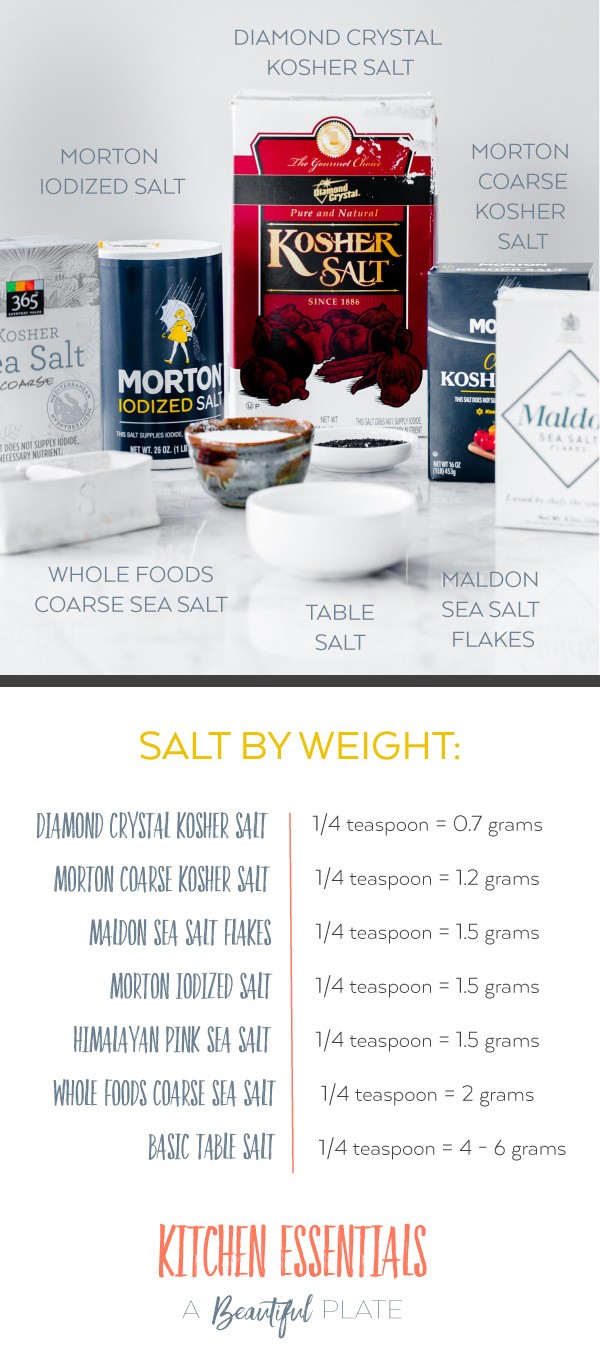
That little known fact is quite crazy and worth discussing, particularly on a website all about food. It is one of those cooking secrets that no one really talks about. This chart explains it all:
Density of Cooking Salts by Brand and Type
Chances are you’ve been aware that different types of salts behave or taste more or less ‘salty’ than others. The obvious enemy of choice is table salt (confession: I hate it).
I think most of us are aware that if a recipe calls for 1/4 teaspoon of sea salt, you can’t simply substitute 1/4 teaspoon of kosher salt and expect the same results. It just doesn’t work that way. This all comes back to density.
But if you take a closer look at the table above (and I highly recommend doing so), you’ll notice something much more note-worthy. The density of the same type of salt varies dramatically by brand.
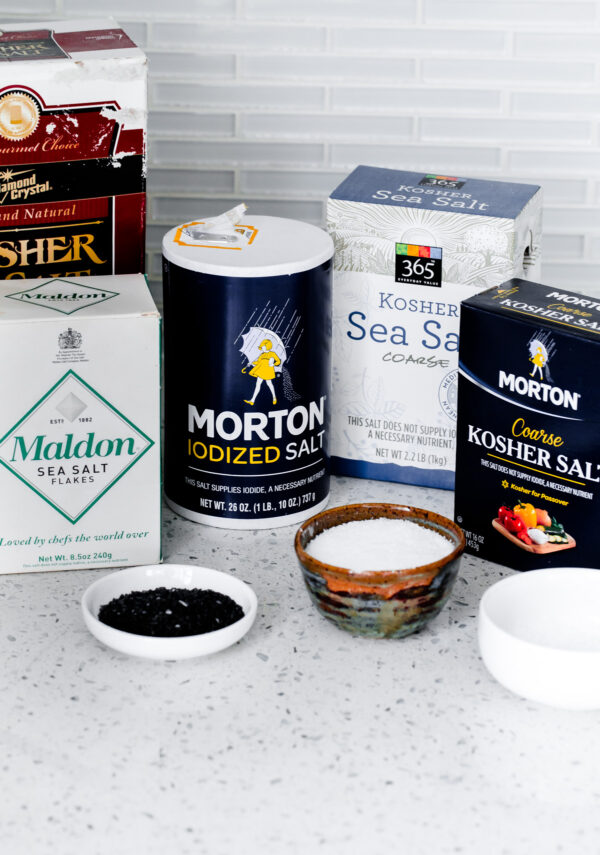
The most glaring example? Kosher salt. One of the most popular types of cooking salts. The two most popular and well-loved brands are Diamond Crystal Kosher Salt and Morton Coarse Kosher Salt.
1/4 teaspoon of Diamond Crystal Kosher Salt weighs approximately 0.7 grams in weight. In comparison, 1/4 teaspoon of Morton Coarse Kosher Salt weighs 1.2 grams. Morton’s Coarse Kosher Salt is almost twice as dense as Diamond Crystal kosher salt. To add an even great layer of complexity to the mix, 1/4 teaspoon of Whole Foods Kosher Coarse Sea Salt weighs 2 grams. That is huge!
In other words, if you’re following a recipe that calls for kosher salt (and that recipe does not specify a brand or weight – and let’s face it, no recipes do), you could end up with a very under-seasoned, or worse, over-seasoned dish.
You may not follow specified salt quantities for this reason. But chances are, you might! If you look at almost any savory recipe on this site, you’ll notice that I do not list salt quantities. I will if it’s critical to a recipe, but I try my best to avoid it for this very reason. It makes me nervous.
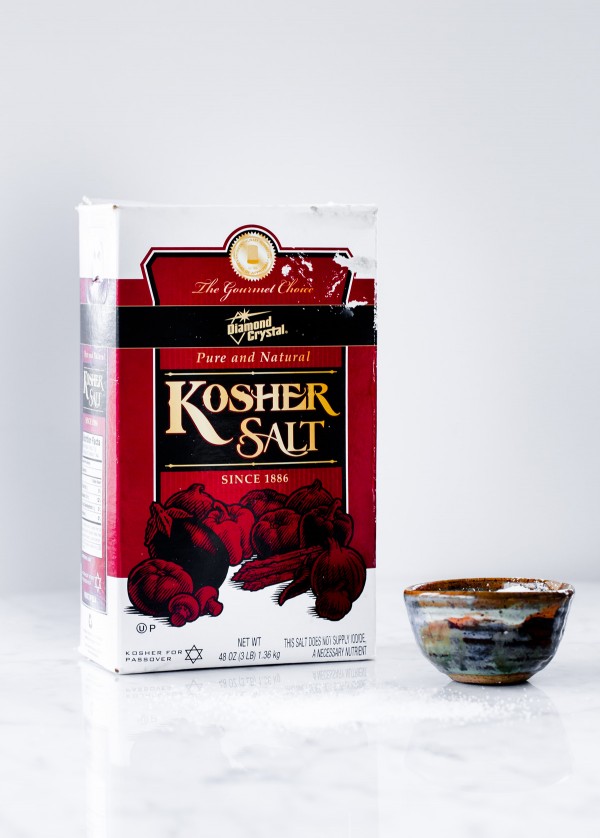
My favorite (highly recommended) cooking salt is Diamond Crystal Kosher Salt. From personal experience, it is the brand of salt used in most professional kitchens and restaurants.
It comes in a 3-lb box and lasts for quite some time. For serving or adding crunch, I turn to popular finishing salts like Maldon or Fleur de Sel.
Why I Love Diamond Crystal Kosher Salt:
- It’s incredibly easy to pinch! I keep a small bowl of it near my stove and this is the only way that I season anything. I strongly advise getting rid of a salt shaker or grinder, and using your fingers for pinching and seasoning as you go! You’ll be able to control and adjust the seasoning of dishes much easier this way.
- It dissolves very well, sprinkles evenly, sticks well to foods, and you can physically ‘grind’ it finer with your fingertips for even faster dissolving. For cooking, you want to use easily dissolvable salts. For finishing, you want to use less easily dissolved salts (Maldon sea salt flakes or Fleur del Sel). But I use Diamond Crystal Kosher Salt for finishing all the time too.
- It is natural, there are no additives, and the flavor is pure.
- It is the least dense variety of kosher salt available – my preference of choice! You won’t over salt a dish with an extra pinch or two.
While this post is my no means an endorsement of one brand or another, I highly recommend seeking and trying out Diamond Crystal Kosher Salt and seeing what you think. If you don’t, simply adjust the quantity of salt to compensate for density, or avoid following salt quantities.
Note on Iodine:
Iodine is an important dietary requirement. Most people eat other iodine-rich foods or take multivitamins that contain iodine that they do not need to use iodized salt (please consult your medical professional) for cooking.
Kosher salt does not contain iodine. If you prefer and need to use iodized salt, please be aware that it can have taste differences and you will need to adjust (substantially reduce) the quantities in most recipes to account for its higher density.
I strongly advise using one type of salt consistently for most of your cooking and seasoning needs. If you constantly switch between sea salt or kosher salt or table salt, you will lose the intuition that comes from using one salt over and over again. I’m so familiar with the relative ‘saltiness’ of Diamond Crystal kosher salt that I know how much I need in order achieve proper seasoning in a dish.
Seasoning is like learning how to ride a bicycle. It can take some practice, but eventually becomes second nature.
50 Comments on “Salt and Why The Type and Brand You Use Matters”
I was shocked to learn the effects of various salts. Shocked. Your explanations made so much sense. Terribly surprised this subject has never been mentioned in years of making recipes from various bloggers
Have tossed ALL of my salts and ordered the 3 pound box of Diamond Crystal Kosher salt.
Thank you immensely.
Thanks so much for this vital info! I’ve been wondering about this subject forever! ❤️
If making a seasoning using Kosher Salt, the flakes break down when mixing. It seems that DC flakes are larger but does that mean they would break down more than Morton Extra Coarse and then the flakes would be almost fine? If that happens, you would expect most of the salt to fall to the bottom of the jar if it’s a coarse ground blend correct?
Diamond Crystal isn’t larger in flake – it’s just much less dense than other kosher salts (Morton) and dissolves a lot more readily. I would personally think a homemade seasoning would only be well mixed with an option like DC, not extra coarse (I would imagine the seasonings would fall to the bottom in that case).
Well I feel like I learned a whole lot in this post of yours about salt, I should tell you that I have been cooking with Morton iodized salt and Tony Chachere‘s Cajun salt as well as other Cajun salt and seasonings for years like slap your mama Cajun seasoning and people love my cooking! We in the south appreciate seasoned food and don’t like under seasoned anything.
I really appreciate your knowledge and experience with salt. I learned valuable insight to help me with my cooking. Thank you.
Thanks so much for your salt post. I often wondered about the differences in the salt varieties. Here in Virginia USA my grocer of choice is Kroger. They usually have whatever I need. I have been buying their brand of Kosher salt for many yrs & do have Morton Iodized salt that I rarely use. That brings to mind this question … does salt go “stale”?
Thanks for all you do! 🙂
Julie
Nope! It doesn’t!
Very helpful! Very useful. This is exactly the breakdown I needed as an amateur home cook. I’ve settled with over salting and never realized the extreme differences in types and brands before. Keep posting more looked this!
So glad it was helpful!
I thought the only difference in salt was whether it was fine or coarse! I have a feeling my cooking (which leaves much to be desired) is about to improve! First flour, now salt! You are amazing!
You’re so kind. Thank you!
Now that you have addressed salt, can you recommend a good pepper grinder. I have bought all the “top” brands for years and none of them seem to last more than 2 or 3 years. I take really good care of them, clean them out regularly and am not doing anything unusual.
I’m really tired of spending $100.00 or more for a pepper grinder to have it fail after 3 years. For that price, I think it should work for life. It’s not a complicated mechanism and every brand touted theirs as the best. After 3 or 4 experiences, I’m buying pepper in a jar with a grinder on top. Very limiting on what types of pepper I can use, but I’m tired of throwing out $100.00 units
Totally understand your frustrations! I have a Peugeot pepper grinder and love it because it comes out very nicely (and can be adjusted easily from coarse to fine), but my parents had one and theirs didn’t work as well. I’ve heard good things about this Cole and Mason grinder, which is a much more reasonable price: https://amzn.to/2swJJKV
I found this article interesting but, to me it missed an important distinction between all the different types or brands of salt, the actual crystal sizes. There isn’t any specified crystal size associated with each type or brand label. The manufacturer grinds the salt down to whatever the manufacturers has determined to make.
Traditionally, kosher salt is the coarsest of the 3 types and this is critical. The larger the crystals, the fewer will fit into a 1/4 teaspoon. Consequently when weighing a 1/4 teaspoon of each one will naturally measure much lower values for the kosher than for the iodized (which has the finest or smallest crystals of the 3 salt types on the market. The sea salt generally falls in between the other two.
Also, all 3 salts mentioned have the same basic chemical formula, which is NaCl indicating that the authors comment re: the differences are due to density may be a bit misleading.
As to the ability to “sprinkle” or “pinch”, this is made possible because of the size of the crystals. The larger the crystals, the more control finger pressure has on the amount pinched, and the easier it is to sprinkle it.
Hi Paul! Thanks for your feedback. Yes – when I’m talking about salt density, I’m referring to crystal sizes and how much it can vary from company to company (even among all kosher salts, etc.). There is a huge distinction between Morton kosher salt and Diamond Crystal kosher salt, for example. Both are coarse, yet Diamond Crystal is much more pinchable and easy to use. Diamond Crystal can be easily pinched into smaller granules with your fingertips – Morton kosher salt can not. Other coarse salts can be very moist, ie. fleur de sel, and I don’t consider those as pinchable – despite the crystal size!
Again, I think you might have missed the point or intention behind the article, so I would encourage you to read it again!