

Sourdough Starter Troubleshooting Guide and FAQ
Basics + FAQ Maintenance Baking Troubleshooting
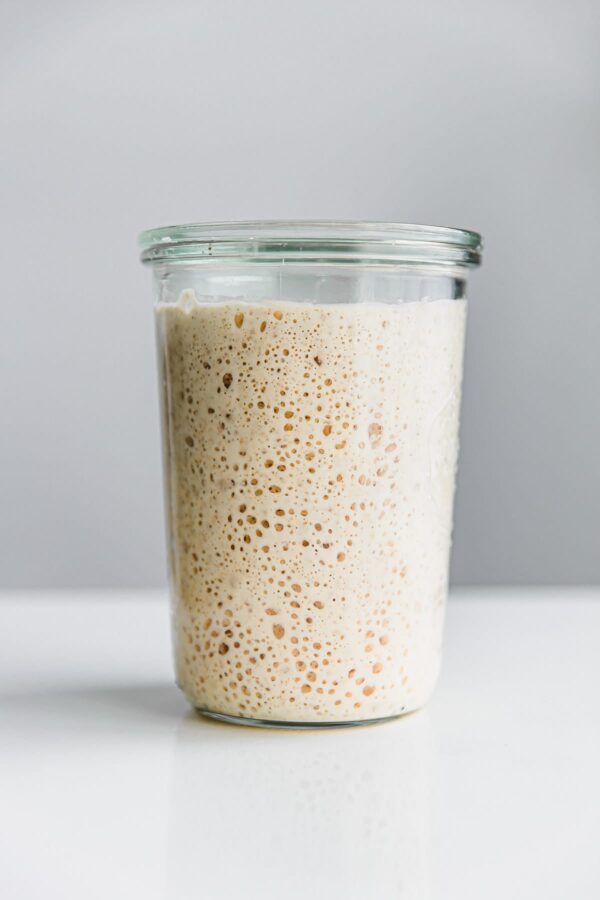
Many people are creating sourdough starters and exploring sourdough for the first time. It’s exciting to see people diving into a subject that I’m so passionate about!
Over the past month, I’ve received many questions on sourdough starters. To create a helpful and easily referenced resource, I’ve put together an extensive Sourdough Starter Troubleshooting Guide below.
If you’ve already established a strong sourdough starter and are experiencing troubleshooting issues related to bread baking, please check out my Sourdough Bread Troubleshooting Guide.
Here you’ll find answers to the following questions and much more:
- How do I get started?
- How can I reduce sourdough discard and waste?
- What flour should I feed my starter? What is a feeding ratio?
- Why isn’t my starter more active? Should I start over? When can I start baking with it?
Note: If you have additional questions not addressed, please leave them in the comment section.
Skip to Various Sections:
Basics + FAQ Maintenance Baking Troubleshooting
Sourdough Starter FAQ:
Q: How do I get started?
A sourdough starter is a culture of naturally occurring wild yeast and lactic acid bacteria used to make naturally leavened, fermented bread. Sourdough starters are active organisms that require regular feedings for best results.
If you’re new to sourdough baking and interested in creating a starter from scratch, I recommend checking out this list of my favorite sourdough resources and tools before getting started.
While I don’t have a sourdough starter recipe, I recommend The Perfect Loaf’s starter guide or Baker Bettie’s starter guide. Be patient as it can take up at least 2 weeks (or longer) to build an active, strong sourdough starter ready for bread baking.
Q: Do I really need a kitchen scale?
Yes. This is less of a deal-breaker for creating a starter, but vital for bread baking if you’re looking to achieve consistent results.
Volume measurements are wildly inaccurate (on that note, be sure to learn how to measure flour properly!) and will not yield consistent results for sourdough baking. I recommend this basic scale, but any accurate scale with 1-gram increments will work.
Q: Where are your starter jars from?
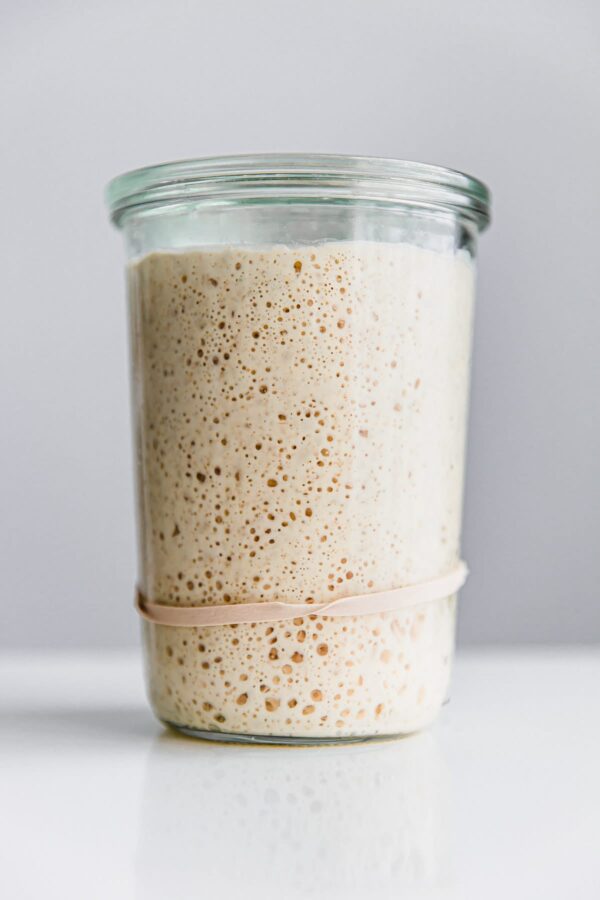
I’ve found Weck jars to be perfect because they’re straight-sided. This makes them easy to clean and offers a visual clue as to your starter’s activity level.
If you would prefer to use something else, choose a container that meets the following criteria: 1) easy-to-clean, 2) glass, 3) includes a lid, which can be set askew or is not airtight, 4) is appropriately sized and allows your starter to grow at least 3-4x in volume.
Q: Do I have to discard sourdough starter? How can I reduce flour waste?
Yes! Discarding part of the starter is required to maintain a healthy sourdough starter. This actually reduces waste, as it means your starter remains small and requires less flour during feedings. Also, please remember that homemade bread is less wasteful and less resource-intensive than packaged store-bought bread.
When I’m not baking bread, I scale down my starter. If I do plan on making bread, I simply scale it up during the previous night’s feeding (same feeding ratios, just larger quantities) before preparing sourdough bread or sourdough pizza dough the next morning. Please remember that you can always scale a starter up or down; the volume of your starter does not have an impact on its strength.
The best way to reduce the amount of sourdough discard during each feeding is to maintain a small starter or use the discard in sourdough discard recipes or for bread baking. You can also compost discard or gift dry sourdough starter to friends.
Note: If you want to use the discard, but don’t want to bake every day, you can compile the discard into one jar at each feeding and store this in the refrigerator. You’ll need to bring it back to room temperature (wake it up!) or give it additional feedings, depending on what you are using it for.
Q: Why do some starter guides call for different types of flours?
Methods will vary depending on a baker’s preference and experience. While you can make a sourdough starter with many flour types (do not use bleached flour for any bread baking), whole grain flours will generally yield faster results.
Rye flour is one of the best, as it is higher in nutrients than other whole grain flours. Extra nutrients will often speed up the process. If you don’t have access to rye flour, organic whole wheat flour is the next best option. Most starter guides will transition flour types and instruct you to change feeding ratios as it builds strength.
Whole grain flours contain the germ and endosperm, which become rancid if stored for extended periods at room temperature. Make sure your flour isn’t spoiled before starting.
Q: What kind of flour should I feed my starter?
Sourdough starters can be made and maintained with many different types of flours. All sourdough starters will behave differently, but different flours will yield different characteristics and flavor profiles.
Once your starter is active, I generally recommend feeding it with the type of flour that you will most often bake with. Therefore, if you’re making mostly whole grain bread, you might want to maintain a whole wheat (or predominantly whole grain) starter.
If you plan on baking with bread flour, you might want to slowly transition it to bread flour or unbleached all purpose flour over time. See more on transitioning to different flour types below.
Q: Can I make a gluten free sourdough starter?
Yes, this is possible! Gluten free starters behave extremely differently and require a completely different baking approach. There are various flour options you can try, so you’ll need to do more research to figure out what is best for you.
I am not experienced with gluten-free sourdough baking, but there are great resources (Vanilla and Bean, as well as King Arthur Flour) out there if you’re interested.
Q: Can I use packaged yeast in my starter?
No! Sourdough starters are cultures of wild yeast/lactic acid bacteria. You cannot jumpstart or create an a sourdough starter from commercial or dried yeast. It sort of defeats the point.
Q: What is a 100% hydration starter? What does that mean?
Hydration refers to water (or other liquids) quantity relative to total weight (grams) of flour. A 100% hydration sourdough starter is fed and maintained with equal parts flour and water by weight. Most sourdough bread recipes call for and use this type of starter.
Starter Maintenance Questions;
Q: Can I switch or transition flour types over time?
If your starter is brand new, I don’t recommend constantly switching your flours (type or brand) as this will impact its activity and can create confusion if you’re looking to establish a solid feeding schedule.
However, if your starter is active and mature, you can change flour type as desired or needed. I recommend transitioning the flours slowly over the course of a week. Remember that flours behave differently and you may need to adjust your feeding schedule.
Q: How do I scale my starter up or down for baking or other reasons?
Simple increase or decrease the quantities in your next feeding using the same feeding ratio (see explanation below) to maintain your current schedule. Example:
Current Starter Feeding: 20 grams starter: 100 grams flour: 100 grams water (1:5:5 ratio)
Scaled Down Starter: 5 grams starter: 25 grams flour: 25 grams water (1:5:5 ratio)
Scaled Up Starter: 40 grams starter: 200 grams flour: 200 grams water (1:5:5 ratio)
Q: Can I preserve my sourdough starter in case something happens? What’s the best way to gift it to other people?
For long term storage, I recommend keeping dried sourdough starter on hand. Follow this guide on how to dry sourdough starter. Great for an emergency back-up or for gifting to friends and family.
Q: Can I refrigerate my starter if I don’t bake frequently?
Yes. If you don’t bake frequently or are going out of town, you can refrigerate a healthy sourdough starter for long period of time. Cold temperatures slow yeast and bacteria activity and will naturally extend how long your starter can sit between feedings.
I don’t recommend continuous refrigeration as it can change the balance of wild yeast/lactic acid bacteria and yield inconsistent results. However, it’s a great option for short-term breaks!
Before refrigerating your sourdough starter, discard a portion and give it a regular feeding. Allow the mixture to sit at room temperature for roughly 1 hour before transferring it to the fridge.
Once you are ready to resume regular feedings or bake with your starter, remove it from the refrigerator and allow it to sit at room temperature (ideally between 74°F-78°F) until it is bubbly and has reached peak activity. Continue with regular feedings and observe its activity.
Depending on how long it has been refrigerated, a refrigerated sourdough starter may require an additional 2 to 3 regular feedings at room temperature before it has resumed regular activity levels and is strong enough for baking sourdough bread or sourdough pizza.
Q: What do you mean by feeding ratio? Which feeding ratio should I use?
Feeding ratios are used to indicate the ratio of sourdough starter, flour, and water in each feeding. Here are a few examples:
1:1:1 ratio = equal amounts of sourdough starter, total flour, and total water by weight. [Eg. 20 grams sourdough starter: 20 grams flour: 20 grams water].
1:2:2 ratio = [Eg. 20 grams sourdough starter: 40 grams flour: 40 grams water]
1:5:5 ratio [Eg. 20 grams sourdough starter: 100 grams flour: 100 grams water]
*Most sourdough starter guides begin with a 1:1:1 ratio. As your starter becomes more active (more wild yeast/lactic acid bacteria), you will change your feeding ratio to account for the increased activity level.
Once your starter is active and on a reliable feeding schedule, you can adapt your feeding ratio as needed to adjust baking timelines, etc.
Sourdough Starter Baking Questions
Q: How do I know when my starter is ready for bread baking?
Before baking, your sourdough starter should rise predictably and be on a reliable, consistent feeding schedule. If your starter is struggling to rise between feedings or taking a significantly long period to reach peak activity, it is most likely not strong enough to leaven bread.
This might vary depending on the type of flour you’re using, but your starter should at least double in volume (or more) at peak activity and pass the float test.
My current feeding and starter activity: My two-year-old starter is currently fed King Arthur unbleached bread flour. Using a 1:5:5 ratio, my starter peaks in about 10-12 hours when held at a temperature of roughly 75F.
Q: Do I have to use my starter at peak activity? Can it be used early or late?
Once your starter is active, you can play with these elements to introduce different flavor profiles into your bread. Younger starters will have a more delicate, sweet flavor. Peaked, slightly fallen starters are higher in acetic acid and will contribute more sourness/tanginess to your loaf.
I prefer to use my sourdough starter at peak activity and when it is just beginning to fall, as this has yielded the best results for me. Remember that changing these variables will impact your dough and bulk fermentation times.
Sourdough Starter Troubleshooting
Q: My starter is developing mold. How do I know if my sourdough starter is bad?
If your starter is developing any mold (pink, etc.), throw it out immediately. There is no way to fix or salvage a moldy starter. Check your flours (are they rancid? spoiling?) before starting over.
Q: My starter isn’t showing any signs of activity and it has been several days. Did I kill my sourdough starter?
Be patient and try placing it in a warmer area of your home (76F-80F is ideal). Use your nose as a guide, as it a better tool than visual activity in the beginning. Use recipes as guidelines, not strict timelines. If your starter peaks in activity, feed it. If it sluggish, wait and give it more time.
Many guides indicate that your sourdough starter should be active and ready for baking within less than a week. This is best case scenario and is not common. Many starters take up to 2 weeks or longer to become active enough to use in bread.
Q: My starter was really active on day 2 and 3, and then there was zero activity. What is happening?
It is common for a sourdough starter to have a surge in activity those first few days and then die down. This is normal and the results of another type of bacteria build up, not an indication that your starter is dead.
It will pick up again with time and the right types of bacteria (wild yeast/lactic acid) will increase and become more stable.
Q: My starter is active, but is barely rising between feedings. What do I do?
Stay the course, be patient, and continue with regular feedings until it strengthens. If you’re using a smaller ratio of sourdough starter in your feedings, consider increasing it until the starter gains more strength.
If your starter is not doubling or growing substantially in volume between feedings, it is not strong enough to leaven dough. You can certainly try baking, but you most likely will not achieve proper fermentation.
Q: Why isn’t my starter passing the float test?
Float tests are not fool-proof, but are generally reliable for 100% hydration sourdough starters (starters that are fed equal portions of flour and water). Failed float tests generally indicate the following:
- Your sourdough starter is too young and not strong enough for bread baking.
- The starter is strong and active, but not quite ready. Allow the starter to sit at temperature for another 30 minutes or hour and test again.
Q: My ambient kitchen is very cold. What can I do?
Wild yeast prefers warmer temperatures. If you’re dealing with cooler temperatures, your sourdough starter will take longer to develop, require more time to peak between feedings, and your bulk fermentation time for bread baking will be extended considerably. This isn’t a deal-breaker, but something to be aware of.
You can try storing your starter in an oven with the light on (please use an ambient thermometer to keep an eye on the temperature as some ovens can easily become too hot). You can also try placing your starter container in a microwave next to a warm bowl of water.
If you’re serious about bread baking and struggling with temperature regulation, I highly recommend a bread proofing box (I own this Brod & Taylor one and love it).
If you enjoyed this post, be sure to check out my other sourdough bread baking resources:
180 Comments on “Sourdough Starter Troubleshooting Guide and FAQ”
Can you give me your starter recipe. I have not had any luck with sour dough starters. Thank you
Hi! There isn’t really such thing as a starter recipe, they all follow the same principles and it takes sometimes up to two weeks for them to get well established. I do 100% hydration and do a combination of rye and bread flour at the beginning!
I have been making sourdough for just about a year with mixed success, sometimes the bread is very good and other times it is very dense. When I watch videos it shows the starter with big, airy bubbles and it jiggles. Sometimes my dough jiggles but I have never had those airy bubbles. What could I be doing wrong? Thank you.
My starter never gets “stringy” like I see on most gf posts. It gets a semi hard top about 1/2″ thick. It seems more like cottage cheese…I’ve been trying for about a month and nothing seems to work.
Gluten free posts? Not sure if that’s what you mean, but this is not a GF starter guide. I would also not describe sourdough starter as stringy, more spongey at the first stir, and then the air will collapse.
Hi. I’m making a new starter and accidently skipped feeding on Day 14. So I’m feeding it on day 15 and then will skip two days before the final feeding. Is it okay that I fed it a day late? Thanks!
Yes! That’s fine! The starter is resilient. It’s most important to just pay attention to what it’s doing and feed accordingly. Not follow any strict formula!
I am on day 6 . my starter is bubbling and doubling can I use the discard after each feeding to bake cookies or cinnamon rolls??
Definitely! If a recipe is simply calling for discard for flavor – you can use it. If a recipe is using it for all the leavening power, I’d be cautious because your starter is very young!
I am a nervous newbie only on day 4 of activating a dried starter I received from a friend. I have been following your instructions and really appreciate all of the information you provide. Here’s my dilemma. I am going out of town for Thanksgiving and will leave midday on day 9 and not return until evening of day 12. Should I feed the starter on day 9, leave it at room temperature for an hour or so and then refrigerate before I go out of town? I wasn’t thinking about being out of town when I started this process ; days ago. I doubt that I will be ready to bake on day 8, correct?
Hi Debbie! I don’t recommend baking on day 8, just to be safe – it really might need some more time, unless it’s already super active – which I find unlikely. I would feed it on day 8, leave it for 3-4 hours at room temperature and then refrigerate it until you get back. Allow to come to room temperature upon your return and see how it’s doing. I would proceed with a feeding at that point and take it from there, it will most likely need more time but it won’t die or be a huge problem in the grand scheme of things, it just might take a bit longer! Frustrating, but absolutely doable. Hope this helps, keep me posted.
Dear Laura,
I have an active starter that is doubling very nicely but the surface doesn’t have the many little bubbles I see on starter images despite being fluffy and airy beneath the surface. This is an old starter I have recently resuscitated with an equal mix of rye and hole grain flours. My feeding ratio is 1:2:2 and I’ve been keeping it in a bread proofing box at 26°C.
What do you recommend I do to achieve the surface bubbling? P.S: I’d like to keep as much rye flour in the mix as possible.
Thank you for your help and for offering much-needed support on your website.
Kind regards,
Mary
My sourdough is rising but not falling anymore. Why is that?
Hi Gabi – I’m struggling to understand what you mean, but I’m guessing that just means that you’re feeding your starter on a reliable schedule. Ideally, the sourdough starter is fed justbefore it falls. If it falls completely, it means it’s been out of food for some time. So, there’s nothing wrong with that!
Hello! I love your info! I’m trying to revive my leaven from ‘putty’ that has been in the fridge for … 5 years? About.
Not a lot happening … I’ve used A LOT OF FLOUR but it’s just not strong enough :/. I presume this means that I’ll have to start again from scratch?
I was getting so excited about being able to make some bread; but every day I feed it and every day a few bubbles – it’s in a warm place on top of my gas fire with pilot light (looks like a wood burner).
Would welcome any feedback but I think I’ll throw it away … Oh well, we learn 😂
Hi! That’s a long time (possibly too long, but not necessarily!) to sit in the fridge without a feeding. With that said, if yoou’re reviving it, it will take some time, possibly a week or two – maybe longer. I’m guessing it’s very acidic right now.
Are you feeding it too often as you’re trying to revive it? If you’re seeing bubbles that’s promising, but I wouldn’t expect it to bounce back super fast due to the long hiatus.